Wednesday, March 11, 2009
The New Ipod Shuffle

Thursday, March 5, 2009
Twittering!

Twitter is a social networking and micro-blogging service that allows its users to send and read other users' updates (known as tweets), which are text-based posts of up to 140 characters in length. Similar to facebook's status feature, members can see what there family members, co-workers, and friends are doing at the moment. Twitter is even being used in politics, (see video), so people in real time can see what there favorite political leaders are saying at the moment. The epitome of Web 2.0
Thursday, February 26, 2009
Apple releases Safari 4 for PC and Mac

Apple released a public beta of Safari 4 for both OS X and Windows on Tuesday, declaring that this new version is loaded with more than 150 features, many of them new. Safari 4 represents quite a technical leap over the previous version of the browser. So which of those new features are you most likely to find interesting, useful, or possibly even a bit disruptive? (If you’re curious as to why some of these features were added, Jason Snell shares his thoughts on that subject.)
Built for speed
The big behind-the-scenes news is the introduction of the Nitro Engine, a super-fast JavaScript engine that executes JavaScript up to 30 times faster than Internet Explorer 7, and three times faster than Firefox 3. To get a sense of the speed increase, I ran a quick test using the SunSpider JavaScript Benchmark on our 2.66GHz iMac with 2GB of RAM. I ran SunSpider in Safari 3, Safari 4 Beta, and Firefox 3.0.6, to get a sense of the speed differences amongst the browsers.
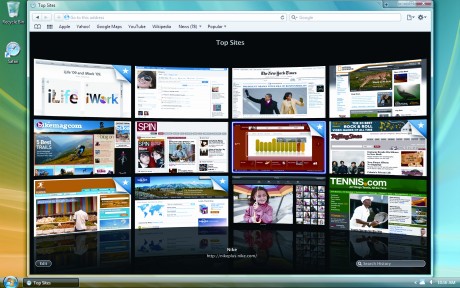
Top Sites
One of the more noticeable changes in Safari 4 is the new Top Sites page, which loads by default when you launch Safari. (You can disable the auto-loading feature in Safari’s preferences if you don’t like it.) Much like the Speed Dial feature in Opera, or the Speed Dial extension for Firefox, or the Most Visited feature in Google Chrome, the Top Sites page shows a page of website thumbnails, making it easy to visit a site with a single click.
-These are not my worlds and were originally created by Rob Griffiths from Mac World
Monday, February 9, 2009
Windows XP's Days are Really Numbered Now
Monday, January 26, 2009
Wifi with a new paint job

IT managers should start familiarizing themselves with a new security tool -- the paint brush -- as Japanese researchers have come up with a paint that they say will block high-speed wireless signals, giving businesses a cheap option to protect their wireless networks.
The problem of securing wireless networks has been an issue for a while now. Wi-Fi LANs with no encryption or running the obsolete WEP system, run the risk of having hackers outside the building eavesdrop on wireless LAN traffic, or simply stealing bandwidth. However, there are a number of solutions, besides encryption, for companies wishing to secure their networks.
For example, Meru Networks said last year that it was using Wi-Fi signals to "cloak" wireless LANs and make it impossible for hackers to decipher them outside the office building. Other methods include putting energy-efficient windows in buildings, physically blocking radio signals or even turning a building or office into a 'Faraday Cage' using mesh metal. However these options tend to be expensive.
But now, according to a report in the New Scientist, paint can be used to secure high-speed wireless networks. This is nothing new though, as RF-blocking paints have been available for a number of years now. Indeed, EM-SEC Technologies successfully tested its own RF-blocking paint back in March 2007 to shield wireless devices and other electronic equipment within a building.
Excerpt taken from PC world who have full owner ship of this article
Friday, January 23, 2009
MacBook Air rival