Wednesday, March 11, 2009

The New Ipod Shuffle


With apple releasing the new ipod shuffle it shows how far ahead of the competition they really are. There new ipod shuffle is slow small it is half the size of the previous model. Now with 4 gigs of memory it can hold up to 1000 songs. Apple has developed voice technology that allows the ipod to tell you what songs you are listening to and your play lists. It also comes in black. The one draw back is that as you can see there is no buttons. The controls are now placed on the new headphones by apple. So what this means is that you are only able to use the Ipod with Apples head phones. So when they were out you have to shell out 30 dollars or more for new headphones to control it. Yes it may have new voice over technology, however the voices are very robot ish and not very smooth. Also it takes forever to wait for playlist to accesed. The new shuffle I believe has been over designed, i think if buttons were placed on the case it would much more user friendly. Im kind of disapointed at apples new creation, coming from a company that is usually the ipitomy of user friendlyness. 

Thursday, March 5, 2009

Twittering!


Twitter is a social networking and micro-blogging service that allows its users to send and read other users' updates (known as tweets), which are text-based posts of up to 140 characters in length. Similar to facebook's status feature, members can see what there family members, co-workers, and friends are doing at the moment. Twitter is even being used in politics, (see video), so people in real time can see what there favorite political leaders are saying at the moment. The epitome of Web 2.0

Thursday, February 26, 2009

Apple releases Safari 4 for PC and Mac


Apple released a public beta of Safari 4 for both OS X and Windows on Tuesday, declaring that this new version is loaded with more than 150 features, many of them new. Safari 4 represents quite a technical leap over the previous version of the browser. So which of those new features are you most likely to find interesting, useful, or possibly even a bit disruptive? (If you’re curious as to why some of these features were added, Jason Snell shares his thoughts on that subject.)

Built for speed

The big behind-the-scenes news is the introduction of the Nitro Engine, a super-fast JavaScript engine that executes JavaScript up to 30 times faster than Internet Explorer 7, and three times faster than Firefox 3. To get a sense of the speed increase, I ran a quick test using the SunSpider JavaScript Benchmark on our 2.66GHz iMac with 2GB of RAM. I ran SunSpider in Safari 3, Safari 4 Beta, and Firefox 3.0.6, to get a sense of the speed differences amongst the browsers.

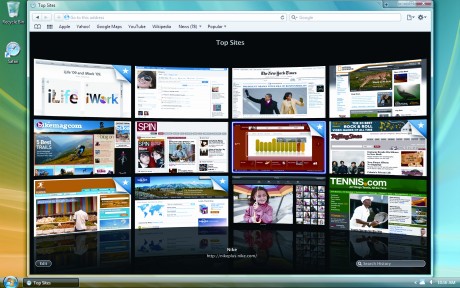
Top Sites

One of the more noticeable changes in Safari 4 is the new Top Sites page, which loads by default when you launch Safari. (You can disable the auto-loading feature in Safari’s preferences if you don’t like it.) Much like the Speed Dial feature in Opera, or the Speed Dial extension for Firefox, or the Most Visited feature in Google Chrome, the Top Sites page shows a page of website thumbnails, making it easy to visit a site with a single click.

-These are not my worlds and were originally created by Rob Griffiths from Mac World


Monday, February 9, 2009

Windows XP's Days are Really Numbered Now

Windows XP, Microsoft's most successful operating system ever, will leave what the company calls "mainstream support" on April 14, and enter "extended support." Typically, Microsoft keeps a product in the former for five years, then moves it into the latter for another five, for a total of 10 years. However, the long span between the releases of XP and its successor, Windows Vista, forced the company to push out the support deadline to 13 years altogether.
-excerpt from pc world.com

Monday, January 26, 2009

Wifi with a new paint job


IT managers should start familiarizing themselves with a new security tool -- the paint brush -- as Japanese researchers have come up with a paint that they say will block high-speed wireless signals, giving businesses a cheap option to protect their wireless networks.

The problem of securing wireless networks has been an issue for a while now. Wi-Fi LANs with no encryption or running the obsolete WEP system, run the risk of having hackers outside the building eavesdrop on wireless LAN traffic, or simply stealing bandwidth. However, there are a number of solutions, besides encryption, for companies wishing to secure their networks.

For example, Meru Networks said last year that it was using Wi-Fi signals to "cloak" wireless LANs and make it impossible for hackers to decipher them outside the office building. Other methods include putting energy-efficient windows in buildings, physically blocking radio signals or even turning a building or office into a 'Faraday Cage' using mesh metal. However these options tend to be expensive.

But now, according to a report in the New Scientist, paint can be used to secure high-speed wireless networks. This is nothing new though, as RF-blocking paints have been available for a number of years now. Indeed, EM-SEC Technologies successfully tested its own RF-blocking paint back in March 2007 to shield wireless devices and other electronic equipment within a building.

Excerpt taken from PC world who have full owner ship of this article

Friday, January 23, 2009

MacBook Air rival


-Excerpt taken from electronista
Normally known only for manufacturing notebooks for others, Quanta is making a system of its own that would compete against Apple's MacBook Air in dimensions but aim at the low end, alleged tips from within the PC industry suggest to Digitimes. The system would measure between just 1-2cm (0.79-0.39in) thick but would be a step in quality above large netbooks like the MSI X-Slim 320, which uses an Intel Atom to keep its price down despite a 13.4-inch display.

Wednesday, January 21, 2009

Whats your system?

With the three major systems on the game market there is a lot of things to consider when purchasing. It all depends if you want portability, quality, reliability, blu-ray, good graphics, motion senors technology, and the most important, game selection.


What
s your system and why?.

Tuesday, January 20, 2009

Bungie reveals information about Halo 3 ODST


Excerpt taken from article planetxbox.xom

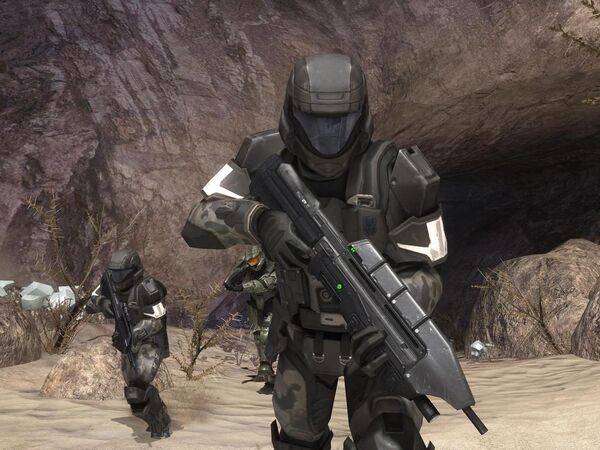
During an interview a bungie representive revealed some information about the new Halo here are some of the good parts.

"You won't ever meet the Chief. Basically, Halo 3: ODST happens while the Chief is away from Earth -- after he leaves for the "Delta Halo" in Halo 2 and before he crashes into the jungle at the start of Halo 3. ODST doesn't cover all the Chief's absence. But it does fill a very interesting part of that gap."

"A lot more tactical, which is to say you need to think before you engage -- decide how you want to take apart an encounter before diving in or you'll get into trouble pretty quick, especially on higher difficulty levels. Unlike a Spartan, an ODST doesn't have shields. You're a little slower too, so if you get hit you can't just run sprint to safety. The golden rule of ODST combat is "look before you leap."

"The silenced SMG is just one of the tweaks to the Halo 3 sandbox that make ODST a stealthier experience -- one that, at least in the open environment of nighttime New Mombasa, rewards a more measured approach to combat. As a non-Spartan, you'll need to be careful about the fights you pick, especially when you're on your own. Luckily the silenced SMG excels at dropping unwary, unshielded enemies."